Asian Journal of Analytical Chemistry
Home - Journal - Asian Journal of Analytical Chemistry
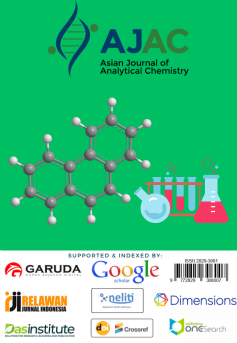
An international Peer-reviewed journal in the field of science related to analytical approach was published by DAS Institute. Asian Journal of Analytical Chemistry welcomes early application of new analytical and bioanalytical methods and technology, demonstrating the potential for societal impact.
Asian Journal of Analytical Chemistry is a member of CrossRef with the DOI prefix number https://doi.org/10.53866/AJAC and an Open Access Journal. Asian Journal of Analytical Chemistry is published twice yearly, in June and December.
We require that methods and technology reported in the journal are sufficiently innovative, robust, accurate, and compared to other available techniques for the intended application. Developments with interdisciplinary approaches are particularly welcome. Systems should be proven with suitably complex and analytically challenging samples.
We encourage developments within, but not limited to, the following technologies and applications:
- Global health, public health, and molecular diagnostics
- Drug development and pharmaceutical analysis
- Drug chemistry and synthesis of drug compounds
- Pharmacognosy, molecular & cellular biology in pharmacy, and phytochemistry
- Drug analysis and quality control
- Biosensors and chemical sensors
- Applied micro fluids and nanotechnology
- Agricultural, environmental, food technology, and food science
- Biochemical and clinical analysis
- Forensic analysis
- Industrial process and method establishment
Asian Journal of Analytical Chemistry is an international scholarly journal in science and technology aimed to publish high-quality scientific papers, including original research papers, reviews, mini-reviews, short communication, and technical notes. The journal welcomes the submission of articles covering a typical science and technology subject, such as Chemistry, Pharmacy, and Biology.
Focus and Scope
The Asian Journal of Analytical Chemistry (AJAC) publishes high-quality research papers, reviews, and short communications that contribute to advancing analytical chemistry and its applications. The journal’s focus and scope include, but are not limited to, the following areas:
Instrumentation and Techniques:
- Novel analytical instruments, methods, and techniques for chemical analysis, spectroscopy, chromatography, electrochemistry, mass spectrometry, and microscopy.
- Development and optimization of analytical instruments and techniques for enhanced sensitivity, selectivity, and accuracy.
Analytical Methods and Applications:
- Development, validation, and optimization of analytical methods for determining and quantifying chemical compounds, elements, drugs, pollutants, toxins, and biomarkers.
- Applications of analytical methods in various fields, including environmental analysis, pharmaceutical analysis, food and agricultural analysis, forensic and toxicological analysis, materials analysis, and bioanalytical chemistry.
Environmental Analysis:
- Environmental samples, such as air, water, soil, and biota, are analyzed to assess environmental quality, monitor pollutants, evaluate remediation efforts, and support environmental management and policy decisions.
- Determination of trace elements, organic contaminants, persistent pollutants, and emerging contaminants in environmental matrices.
Pharmaceutical Analysis:
- Analysis of drugs, pharmaceutical formulations, drug delivery systems, and pharmacokinetics using various analytical techniques to ensure their quality, safety, and efficacy.
- Development of analytical methods for drug analysis, impurity profiling, stability testing, and bioavailability studies.
Food and Agricultural Analysis:
- Analysis of food products, agricultural samples, additives, contaminants, and residues to ensure food safety, authenticity, and quality control.
- Determination of nutrients, toxins, pesticides, veterinary drugs, and other chemical contaminants in food and agricultural matrices.
Forensic and Toxicological Analysis:
- Analytical methods for identifying, quantifying, and detecting drugs, toxins, poisons, and other substances of forensic and toxicological importance.
- Biological samples, such as blood, urine, hair, and tissues, are analyzed for forensic and toxicological investigations.
Materials Analysis:
- Analysis of materials, including polymers, nanomaterials, catalysts, and composites, to study their composition, structure, and properties using advanced analytical techniques.
- Characterization of materials for quality control, performance assessment, and optimization of manufacturing processes.
Bioanalytical Chemistry:
- Analyse biomolecules, such as proteins, nucleic acids, carbohydrates, and metabolites, for biomarker discovery, disease diagnosis, drug monitoring, and understanding of biological processes.
- Development and application of analytical methods for proteomics, genomics, metabolomics, and other areas of bioanalysis.
Quality Control and Method Validation:
- Studies on quality control procedures, method validation protocols, reference materials, and proficiency testing to ensure accuracy, precision, and reliability of analytical measurements.
- Evaluation and comparison of different quality control approaches and their implementation in analytical laboratories.
The Asian Journal of Analytical Chemistry welcomes contributions from researchers and scientists across the globe, with a particular emphasis on Asian perspectives and applications. The journal aims to foster scientific exchange, promote innovative research, and facilitate the dissemination of knowledge in analytical chemistry.
Please note that the focus and scope provided serve as general guidelines. The journal may consider exceptional articles outside these areas if they contribute significantly to the field of analytical chemistry.
For further details regarding manuscript submission and formatting guidelines, please refer to our website or contact the editorial office directly.
Peer Review Process
Setiap artikel akan direview secara baik oleh peer reviewer. Pengelola jurnal menjamin bahwa setiap proses review penulis tidak mengetahui siapa reviewernya. Waktu yang diperlukan untuk review adalah 1 (satu) minggu setelah artikel ini diterima oleh reviewer.
Publication Ethic
The Asian Journal of Analytical Chemistry (AJAC) is committed to upholding the highest standards of publication ethics. Authors, reviewers, and editors are expected to adhere to the following ethical guidelines:
Authorship:
- All authors listed on a manuscript should have made significant contributions to the research.
- The corresponding author should ensure that all co-authors have reviewed and approved the final version of the manuscript.
- Any changes in authorship, including additions, deletions, or order changes, should be approved by all parties involved and communicated to the journal.
Plagiarism:
- Authors should ensure that their work is original and does not include any form of plagiarism, including verbatim copying, paraphrasing, or appropriation of ideas without proper citation.
- Proper referencing and citation of all sources used, including one’s own previous works, is essential.
Data Integrity and Fabrication:
- Authors should present accurate and reliable data, ensuring that research findings are based on sound methodologies and that any manipulations or fabrications of data are avoided.
- All data, including raw data and statistical analyses, should be properly documented and made available upon request.
Conflicts of Interest:
- Authors should disclose any financial or non-financial conflicts of interest that may influence the research, the interpretation of results, or the manuscript preparation.
- Any funding sources or affiliations that could be perceived as potential conflicts of interest should be acknowledged.
Ethical Treatment of Human and Animal Subjects:
- Research involving human subjects should comply with ethical standards and obtain appropriate informed consent, and any potential risks to participants should be minimized.
- Animal experiments should follow relevant guidelines and regulations, and efforts should be made to minimize animal suffering.
Review Process:
- Reviewers should conduct the peer-review process objectively, providing constructive feedback and maintaining confidentiality regarding the manuscript and its contents.
- Reviewers should promptly disclose any conflicts of interest that may influence their judgment and decline to review if necessary.
Editorial Independence:
- Editors should ensure the fair and unbiased handling of all manuscripts, regardless of the authors’ nationality, ethnicity, gender, or institutional affiliation.
- Editors should base their decisions on the manuscript’s scientific merit, relevance, and adherence to the journal’s guidelines.
Corrections and Retractions:
- Authors should promptly notify the journal if they discover any significant errors in their published work and cooperate with the editors to issue corrections or retractions, as appropriate.
- The journal reserves the right to retract or correct published articles if ethical violations, errors, or misconduct are identified.
Intellectual Property Rights:
- Authors should respect intellectual property rights and obtain proper permissions for the use of copyrighted materials, including figures, tables, images, and text.
Transparency and Openness:
- Authors should provide accurate and complete information about their research, methodology, and data to allow for reproducibility and transparency.
- Authors should comply with any data-sharing policies or requirements set by the journal.
Reporting Standards:
- Authors should follow the journal’s formatting and submission guidelines and ensure that their manuscripts are presented clearly, accurately, and ethically.
- Proper acknowledgment of the contributions of others, including funding sources, is essential.
The Asian Journal of Analytical Chemistry takes any ethical misconduct seriously. In cases of suspected misconduct or violations of publication ethics, appropriate actions will be taken, which may include notifying relevant institutions and initiating investigations.
By adhering to these ethical guidelines, authors, reviewers, and editors contribute to the integrity, credibility, and trustworthiness of scientific research and the publication process.
Author Guidelines
Author Guidelines
The submitted manuscript for publication to Asian Journal of Analytical Chemistry (AJAC) should be original research work with high academic merit and should be contributed solely to the Asian Journal of Analytical Chemistry (AJAC), not previously published and not under consideration for publication in the other publisher elsewhere and free from plagiarism. The manuscript that does not meet those requirements will be automatically rejected.
All the submitted manuscript to Asian Journal of Analytical Chemistry (AJAC) will be peer-reviewed by at least two independent referees.
Submission Criteria
Manuscript submitted for publication in the Asian Journal of Analytical Chemistry (AJAC) should be appropriate with the following criteria:
- It must be written in good English language.
- It must be within the scope of the journal.
- Must be original, have not been published elsewhere, and will not be submitted to any journal during the review process.
- Must be following the journal instructions and have correct style before being considered for reviewing process.
Preparing Manuscript file
Asian Journal of Analytical Chemistry (AJAC) accepts manuscripts in the form of Research article, Review articles, and short communication. As an approximate guide to length as follows:
- Research article would not normally exceed 8 pages.
- Review article would not normally exceed 15 pages.
- A short communication article would not normally exceed 6 pages.
The manuscript must be prepared using word processing software, e.g., Microsoft Word, Open Office, Libre Office, etc, with document format doc, or docx.
Manuscript Structure
Title
Title of the manuscript must be concise and informative.
Author names and affiliation
Make sure that the author’s name clearly indicates the given name and family name of each author. Present the authors’ affiliation below the author names. Add a number in superscript letters after the author’s name and before the appropriate address. Provide the full postal address of each affiliation, including the name of the author’s country and email address. Clearly provide who will handle correspondence at all stages of refereeing and publication and after publication.
Abstract
The abstract must be concise and factual and should briefly state the purpose of the research, the methods used, the principal results, and the main conclusion. Due to the abstract being occasionally presented separately from the full article, it should be able to stand alone and not contain references. The use of non-standard or uncommon abbreviations should be avoided, but if necessary, they must be defined as they are mentioned in the abstract body.
Keywords
The keyword should be provided immediately after the abstract. It provides a maximum of 6 words, the keyword of the whole article. These keywords will be used for indexing purposes.
Graphical Abstract
In order to encourage and draws more attention from the online reader, the editorial highly recommends a Graphical abstract. The graphical abstract should summarize the full content of the article. The graphical abstract could be submitted with the main manuscript and as a separate file in the online submission system. The graphical abstract image should be readable with a minimum size of 500 x 1300 pixels (h x w) or proportionally more.
Editorial Team
Editor in Chief
Muhammad Abdurrahman Munir, Scopus ID: 57210343162, Universitas Alma Ata, Yogyakarta, Indonesia
Managing Editor
Ahlam Inayatullah, Scopus ID: 57222487654, Politeknik Negeri Sriwijaya, Palembang, Indonesia
Editor
Chemayanti Surbakti, Scopus ID: 56626013500, Universitas Sumatera Utara, Medan, Indonesia
Eda Yuhanna Ariffin, Scopus ID: 42860928400, Universiti Kebangsaan Malaysia, Kuala Lumpur, Malaysia
Andi Wahyudi, Scopus ID: 57200658035, Universitas Alma Ata, Yogyakarta, Indonesia
Reviewer
Daru Estiningsih, Universitas Alma Ata, Yogyakarta, Indonesia
Ika Puspitasari, Universitas Alma Ata, Yogyakarta, Indonesia
Ndaru Setyaningrum, Universitas Alma Ata, Yogyakarta, Indonesia
Denny Satria, Scopus ID: 46662031100, Universitas Alma Ata, Yogyakarta, Indonesia
Effendy De Lux Putra, Scopus ID:56232713900, Universitas Alma Ata, Yogyakarta, Indonesia
Sutarmin, Scopus ID: 57191952910, Universitas Peradaban, Indonesia
IT Support
Agus Darmawan, Universitas Gajah Mada, Yogyakarta, Indonesia
Reviewers
Daru Estiningsih, Universitas Alma Ata, Yogyakarta, Indonesia
Ika Puspitasari, Universitas Alma Ata, Yogyakarta, Indonesia
Ndaru Setyaningrum, Universitas Alma Ata, Yogyakarta, Indonesia
Denny Satria, Scopus ID: 46662031100, Universitas Alma Ata, Yogyakarta, Indonesia
Effendy De Lux Putra, Scopus ID:56232713900, Universitas Alma Ata, Yogyakarta, Indonesia
Sutarmin, Scopus ID: 57191952910, Universitas Peradaban, Indonesia
Author Fees
| Article Submission Fee |
0.00 (IDR) Authors ARE NOT REQUIRED to pay an Article Submission Fee as part of the submission process. This part of APC or Article Processing Charge is Free. |
| Fast-Track Review |
100.000 (IDR) (for Indonesian author) and $10 (for foreign author). With the payment of this fee, the review, editorial decision, and author notification on this manuscript is guaranteed to take place within 8 weeks. This payment, however, IS NOT A PROMISE on when the manuscript will be published. |
| Article Processing Charge |
100.000 (IDR) (for Indonesian author) and $10 (for foreign author) If this paper is accepted for publication, you will be asked to pay an Article Publication Fee to cover publications costs. |
Open Access Policy
This journal provides immediate open access to its content on the principle that making research freely available to the public, supports a greater global exchange of knowledge. This journal is open access journal, which means that all content is freely available without charge to users or institutions. Users are allowed to read, download, copy, distribute, print, search, or link to full text articles in this journal without asking prior permission from the publisher or author. This is in accordance with the Budapest Open Access Initiative.
Contact
Contact
Perum Palm Estate No. 6A, Penambongan, Purbalingga, Jawa Tengah, Indonesia
53314